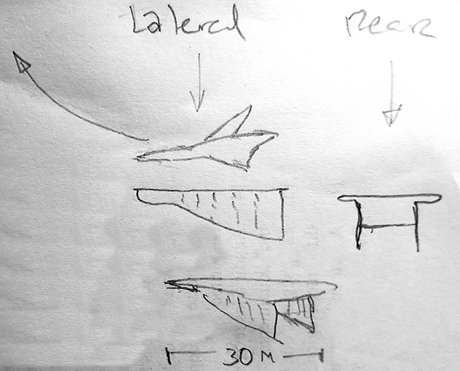
My car was parked in an open-air parking lot, located in an industrial area near an airport. I was walking there to get it and go home. One of the companies that were close to the parking lot was SpaceX, and you could immediately notice the tremendous airspace activity that they were having all around their building and on the nearby airport. Their planes were both landing and taking off into the air by the minute. There were different kinds of planes. One type was a cargo holder; its design was that of what you could imagine from a flying cargo ship: a long flat top structure, but with a double long vertical stabilizer on the bottom. This type of plane was being used to take supplies to space facilities. Due to the amount of these planes docking and undocking, it looked like the need for those supplies was plentiful.
Another function you could observe on this type of planes was their capacity to carry a jet plane on top of them, like in a piggyback ride. They would carry the jet until they had reached a safe altitude (somewhere above the level of the city tallest building) where the plane being carried would be able to take off by itself.
Without realizing it, I slowed my pace until I totally stopped and was standing there, amazed at this flying activity in the middle of the city and at the extremely fast and precise way that some of the planes were coming and going.
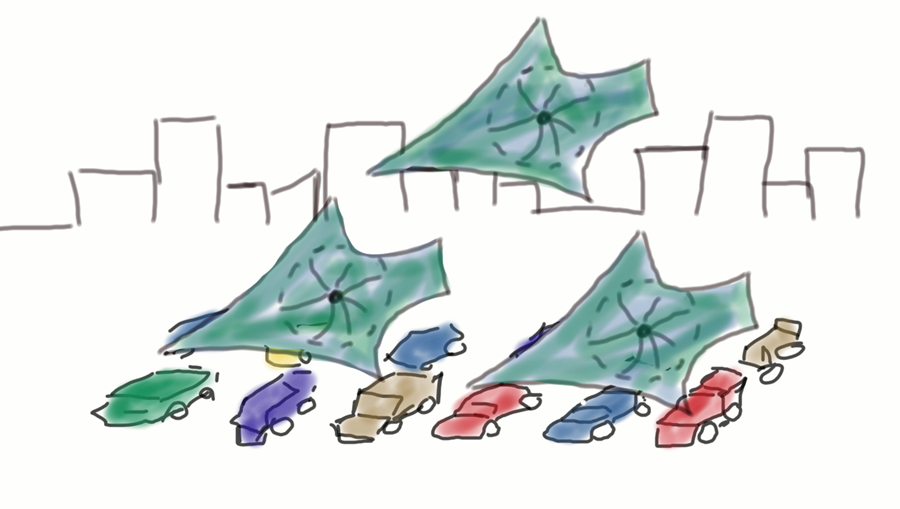
Their precision of movement was what made me notice a separate set of planes. They were moving in groups of three, in a perfect and really fast synchronized formation. It was as mesmerizing as terrifying to see them. They were performing a test “to the limit,” ordered by Mr. Elon Musk.
A test? To the limit? In the middle of the city? On top of the parking lot where I had my car? And what does “to the limit” mean?
Each squadron of these airplanes was doing its own maneuvers and acrobatics at perfect unison. They would go up vertically, turn to a side, go down, get parallel to the earth and then go on a 45-degree angle to the ground, all in a continuous movement. From my perspective, all the maneuvers they were doing were mainly sideways, so most of the time I was only seeing the bottom of the planes. Then I noticed that they were getting closer until they were flying and maneuvering just above my head and were no farther than 50 meters from the ground. It was startling to realize the incredibly low level of noise they were producing; no wonder there were no complaints heard of from the area residents.
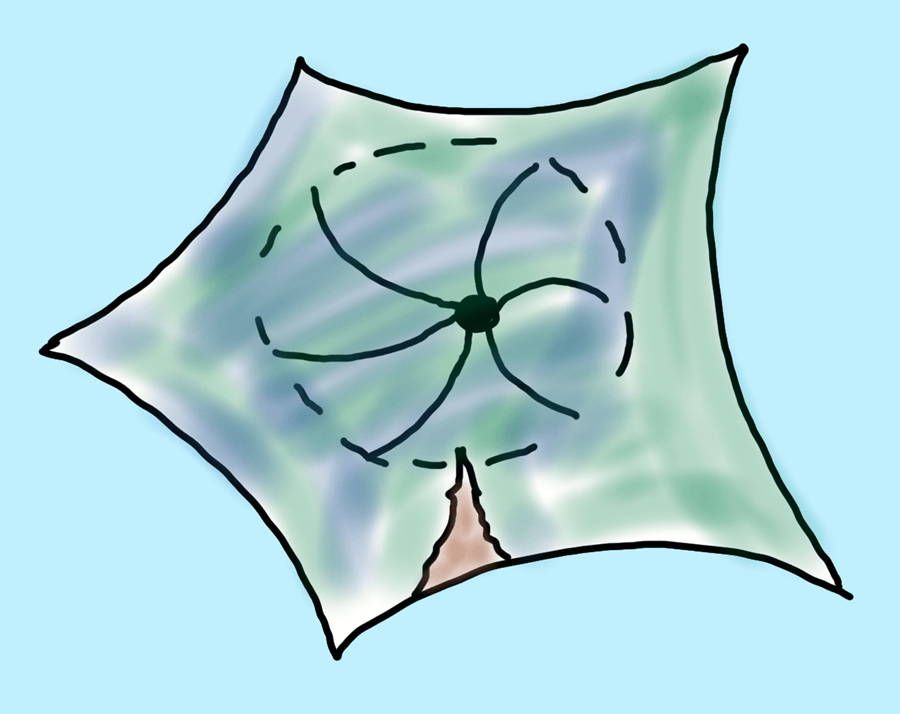
These planes were made of an alloy that combined metal, polymers and organic material that allowed them to be extremely flexible and adapt the arch of their wings and the convexity of the bottom to get those precise, fast movements. The structure, design, and adaptive shaping resembled a stingray.
I was enthralled trying to absorb what I was looking at but then just in front of me it happened; one of the three planes that were maneuvering on top of me suffered a rupture at the material covering its bottom. It looked as when a piece of elastic cloth rips with the pressure of being pulled in all directions. My brain was filled with the word catastrophe! But as soon as it ripped the plane safety mechanism took over. It was located at the bottom of the plane and was a circular structure that worked like those pull cords used to close the mouth of bags. Faster than I could process it the bottom part of the plane became rigid and flat adopting the same shape as of any regular jet. Immediately after, the troubled plane broke formation and started flying at a regular speed and motion already slowing down and looking to land. At that same instant, she came rushing to the room asking for a scissor. I realized I had fallen asleep on my desk. What a rush!








Leave a Reply